

What happens when you spend eight months living and working in one of the most remote and extreme environments on Earth?
Members and guests of the Rotary Club of Mt Eliza were given a fascinating glimpse into life in Antarctica when Dr Stuart Kininmonth, Winter Station Leader at New Zealand’s Scott Base, joined us virtually from Antarctica.
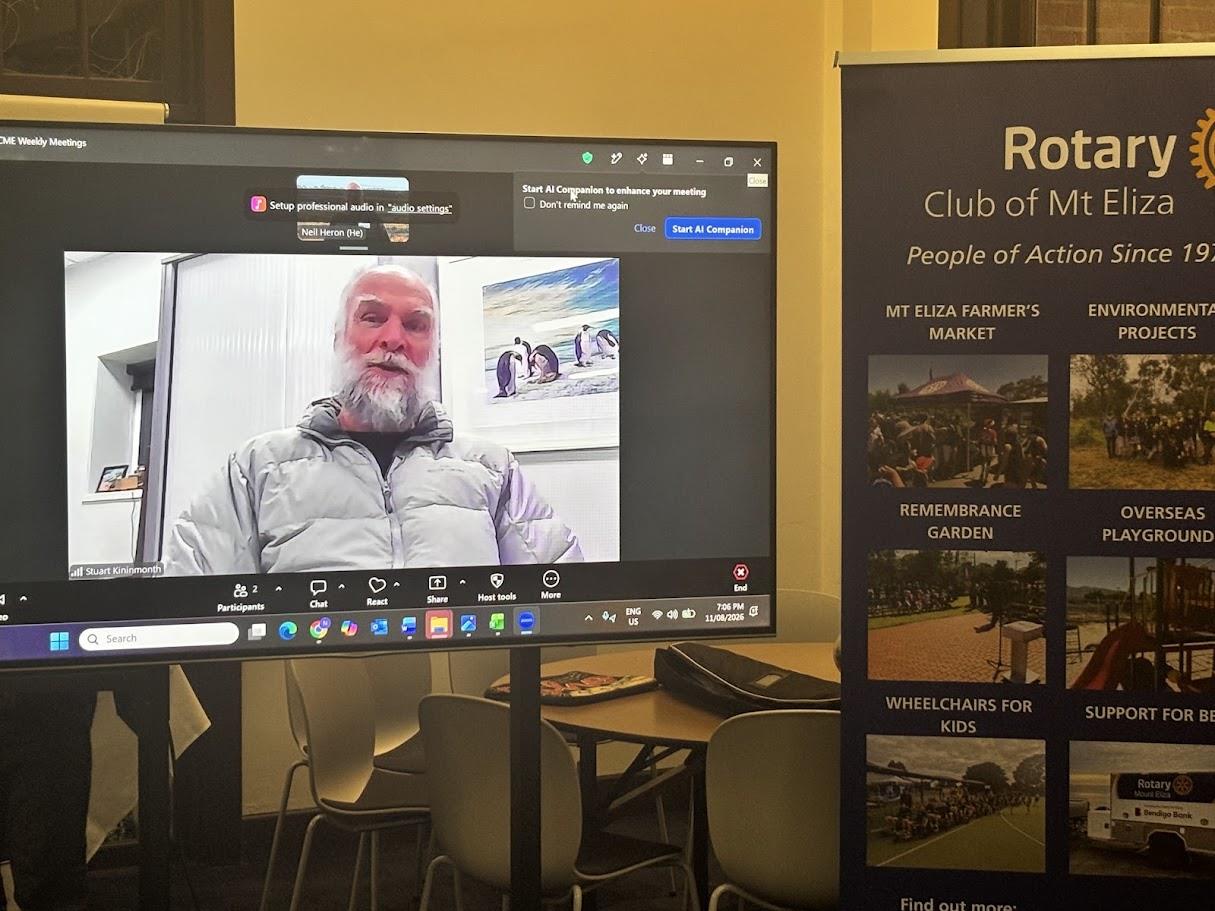
It was an extraordinary opportunity to hear first-hand about the environment, the science, the wildlife and, perhaps most importantly, the human experience of spending months isolated from the rest of the world.
From 24-hour sunlight to months of darkness
Stuart arrived in Antarctica towards the end of January, when the station was experiencing almost continuous daylight.
Over the following months, the sun gradually disappeared below the horizon. By 24 April, Stuart had seen the sun for the last time.
For more than two months, the station was immersed in almost complete darkness.
As he explained, the transition is gradual. The 24-hour daylight of summer slowly becomes a more familiar cycle of day and night, before the sun eventually disappears altogether.
By August, however, there are signs that the sun is returning. Stuart described the beautiful red twilight and sunsets that are now appearing on the horizon, offering a welcome reminder that winter is slowly coming to an end.
For the people living at Scott Base, the return of sunlight is more than simply a change in the weather. It marks the beginning of a new phase in life at the station.
Life at Scott Base
Scott Base is New Zealand's scientific research station in Antarctica.
During winter, the station operates with a small team of around 12 people, largely made up of tradespeople, engineers and other specialists responsible for keeping the station functioning.
They maintain the power, water, buildings, vehicles, communications and countless other systems that are essential to life in such an isolated location.
During the summer research season, the population can increase dramatically, with up to around 140 people at the station.
Summer is when much of the field science takes place. With continuous daylight and more accessible conditions, researchers can travel further into the Antarctic environment to conduct their work.
Stuart gave us an insight into just how extreme the environment can be. Temperatures can fall to around -40°C, with wind chill making conditions even more severe.
Yet, surprisingly, he said the cold and the darkness were not necessarily the greatest challenges.
The human challenge of isolation
Perhaps one of the most interesting parts of Stuart's presentation was his discussion about the people who live and work together at Scott Base.
When the winter team arrives, they may be complete strangers. But they quickly become a small community, living and working together in extremely close quarters for many months.
As Stuart explained, people learn each other's habits, personalities, likes and dislikes. Over time, the ability to compromise and adapt becomes essential.
The challenge is not simply being away from home. It is being unable to escape from the same group of people.
Stuart compared the experience with the idea of a future Mars mission, observing that Antarctica provides an interesting insight into the psychological and social challenges of living in an isolated environment.
The Antarctic team must learn to recognise and manage the everyday stresses that can build up when there is no easy way to get away or take a break from the environment.
As station manager, Stuart's role includes helping the team navigate those situations and supporting the wellbeing of the people in his care.
Science at the bottom of the world
While life at Scott Base is fascinating in itself, the station exists primarily to support scientific research.
During winter, Stuart and his team are involved in a range of atmospheric monitoring activities.
Sophisticated instruments measure different aspects of the atmosphere, including ozone and atmospheric particles. Some instruments use lasers to study the atmosphere above the station.
The information collected contributes to the international understanding of the atmosphere and the changes taking place within it.
Stuart also spoke about measuring the light spectrum reflected from the Moon. By analysing how light changes as it travels through the atmosphere, scientists can obtain valuable information about atmospheric conditions.
Another fascinating area of research involves lightning.
When lightning strikes anywhere around the world, it produces electromagnetic waves that travel around the Earth. Instruments in Antarctica can detect these signals, allowing scientists to monitor lightning activity across the globe.
This information is important because lightning can influence the chemistry of the atmosphere and is another piece of the complex puzzle researchers are trying to understand.
An international scientific community
One of the key messages from Stuart's presentation was the importance of international cooperation.
Antarctica is enormous, covering an area roughly twice the size of Australia, yet there are relatively few scientific stations spread across the continent.
No single station could possibly monitor everything that is happening.
Research teams therefore share information and collaborate with scientists from other countries, including Australia, Italy, the United States, South Korea, China and many others.
Together, these observations help researchers build a much more comprehensive picture of what is happening across Antarctica and how the continent is responding to a changing climate.
A changing Antarctic environment
Climate change was naturally an important part of the discussion.
Stuart explained that Antarctica is not responding to climate change in a simple or uniform way. Conditions vary significantly across the continent, making long-term monitoring particularly important.
Scientists are watching changes in sea ice, ice shelves, atmospheric conditions and marine ecosystems.
The implications extend far beyond Antarctica.
Large-scale changes to Antarctic ice could have profound consequences for sea levels around the world, particularly for coastal communities and major cities.
Understanding exactly how the Antarctic environment will respond to increasing concentrations of greenhouse gases remains one of the major scientific challenges.
Stuart emphasised that while scientists can observe changes and develop models, there is still much to learn about how those changes will manifest in different parts of the world.
Penguins, marine life and Antarctic giants
During the summer months, scientists at Scott Base undertake research into an extraordinary range of Antarctic wildlife, including penguins, seals, whales and fish.
The surrounding marine environment is also an important area of research.
Stuart described the phenomenon known as Antarctic gigantism, where some marine species grow considerably larger than their counterparts in warmer waters.
Species such as sea spiders and other marine invertebrates can reach remarkable sizes.
The cold water and relatively low metabolic rates are thought to contribute to this phenomenon, allowing organisms to survive and grow in ways that are very different from those seen in warmer environments.
Researchers are also monitoring the Antarctic food chain, including plankton and krill, and the potential implications of environmental change for the animals that depend upon them.
The spectacular Antarctic night sky
With virtually no light pollution, Antarctica might seem like the perfect place to observe the stars.
Stuart described the incredible darkness and the opportunity to see the Milky Way and auroras.
The Southern Lights, or Aurora Australis, are one of the extraordinary natural phenomena visible from Antarctica.
He also had the unexpected experience of seeing a train of Starlink satellites crossing the Antarctic sky, a striking reminder of the contrast between one of the most remote environments on Earth and modern technology.
And despite the incredible darkness, Stuart noted that the stars don't necessarily appear as bright as one might expect. The science behind the Antarctic atmosphere, magnetic field and visibility makes the experience more complicated than simply removing light pollution.
Waiting for the winter resupply
For the winter team, one of the biggest events of the year is the arrival of the winter resupply flight.
After months without fresh food and with very limited contact with the outside world, the arrival of aircraft brings fresh supplies, equipment, mail and a connection with the world beyond Antarctica.
Stuart said the fresh food would be particularly welcome after the long winter.
The arrival of the aircraft also marks an important psychological milestone. The team knows that winter is beginning to give way to spring and that the station will soon become much busier.
Further flights will arrive later in September as the summer research season gets underway.
Stuart expects to leave Antarctica around early October, bringing his remarkable eight-month experience to an end.
The Midwinter Feast
Not everything about Antarctic life is scientific or serious.
One of the highlights of the winter calendar is the famous Midwinter Feast, held around the middle of the Antarctic winter.
It is a major event at the station, providing an opportunity for the winter team to celebrate together and mark the halfway point of their deployment.
There is a six-course meal, elaborate decorations and plenty of entertainment.
After months of darkness, isolation and routine, the Midwinter Feast provides something to look forward to and reminds everyone that the halfway point has been reached.
What happens when you come home?
One of the questions from our members was what it is like to return to ordinary life after such an extraordinary experience.
Stuart explained that there can be a significant period of adjustment.
After months of isolation, returning to family, friends, crowds, traffic, shops and everyday routines can be surprisingly challenging.
There is even a saying among Antarctic workers:
The first year is for adventure. The second is for the money. The third is because you can't live anywhere else.
For some people, Antarctica becomes much more than a temporary workplace. It becomes a place that is difficult to leave behind.
A truly memorable Rotary meeting
Our members asked Stuart about everything from penguins and climate change to scientific collaboration, internet connectivity, beards, light pollution and what it is like to live in complete darkness.
The conversation was a wonderful example of the breadth of experiences and knowledge that Rotary can bring into our meetings.
Most of us will never have the opportunity to spend eight months in Antarctica. Through Stuart's presentation, however, we were able to experience a small part of that world from the comfort of Mt Eliza.
His presentation left us with a much greater appreciation of the extraordinary environment that is Antarctica, the scientists and support teams who work there, and the importance of international cooperation in understanding our changing planet.
We sincerely thank Dr Stuart Kininmonth for taking the time to speak with the Rotary Club of Mt Eliza and for sharing such an engaging, informative and very personal insight into life at the bottom of the world.
It was a memorable evening, and a timely reminder that some of the most important questions facing our planet are being explored in some of its most remote and remarkable places.