

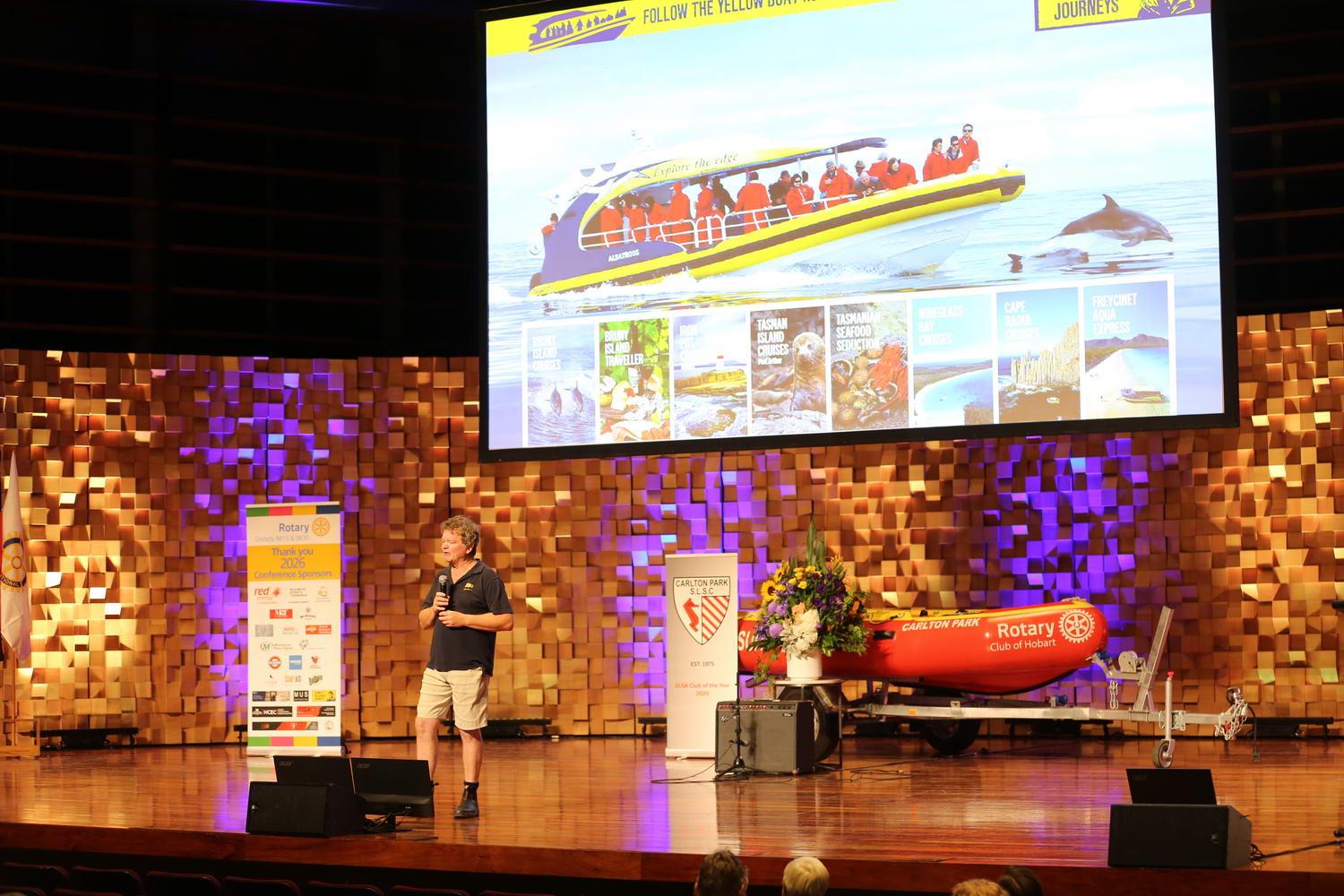
Rotarians attending the recent District 9815 Conference in Hobart were treated to an inspiring keynote presentation from one of Australia’s most respected tourism innovators, Robert Pennicott.
Robert’s story began on the waters south of Hobart, where as a young boy he spent countless hours fishing around the coast. What started as a childhood passion gradually evolved into a career that would ultimately shape one of the most celebrated tourism experiences in Australia.
Today, Robert is the founder of Pennicott Wilderness Journeys, the organisation behind iconic eco-tourism experiences including Bruny Island Cruises, which showcases Tasmania’s dramatic coastline, towering sea cliffs and abundant wildlife.
From humble beginnings operating a small 12-seat vessel in 1999, the business has grown into a major tourism enterprise employing around 170 staff, operating numerous vessels and tours, and welcoming visitors from around the world. Along the way it has become one of Australia’s most awarded tourism businesses, recognised for both innovation and environmental leadership.
Adventure, Risk and Determination
Robert’s journey to success has been anything but conventional.
In a story that had conference attendees both laughing and holding their breath, he recounted one of his most ambitious conservation fundraising efforts — a circumnavigation of Australia in a 5.4-metre inflatable boat as part of the Follow the Yellow Boat Road expedition.
The journey took months and involved navigating remote coastlines, sleeping in tiny boats, enduring severe weather conditions and even encountering crocodiles in northern Australia. Despite the risks, the expedition raised nearly $300,000 for conservation projects and Rotary initiatives.
For Robert, however, the adventure was about more than just the challenge.
It was about raising awareness of the fragile marine ecosystems that surround Australia and the responsibility we all share to protect them.
Business with Purpose
While the tourism success story is impressive, Robert emphasised that the true measure of success lies in giving back.
Through the Pennicott Foundation, the organisation now supports hundreds of environmental and community initiatives each year, with contributions ranging from local school programs and beach clean-ups through to large-scale environmental research projects.
One of the most significant current projects involves collaboration with researchers from the Institute for Marine and Antarctic Studies at the University of Tasmania to investigate the ecological health of the D'Entrecasteaux Channel.
Over recent decades, parts of the channel have experienced significant environmental change, including declining water quality and the growth of nuisance algae. Through detailed scientific research, Robert hopes to better understand the causes and identify solutions that will protect these waters for future generations.
Sustainability at the Core
Throughout his keynote address, Robert returned repeatedly to a central idea: sustainability must sit at the heart of everything we do.
For him, sustainability is not just about protecting the environment. It also includes building strong communities, supporting employees and creating businesses that contribute positively to society.
With approximately 170 staff across multiple tourism operations, Robert spoke proudly of the culture that has been built within the organisation — one focused on teamwork, shared purpose and a commitment to caring for Tasmania’s natural environment.
A Message That Resonated with Rotary
Robert’s story resonated strongly with Rotarians attending the conference.
His commitment to community impact, environmental stewardship and global citizenship aligns closely with Rotary’s guiding principle of Service Above Self.
From the early days of fishing as a young boy to leading a world-recognised tourism organisation, Robert’s journey is a powerful reminder that passion, perseverance and purpose can create extraordinary outcomes.
As Rotarians left the conference session, many did so inspired not only by Robert’s adventures, but by his belief that individuals and organisations alike have the power to make a meaningful difference in the world.